

What are the installation and setup processes for BT Business Broadband services?
Discover the setup and installation processes for BT business internet services. Improve your SME's connectivity with our easy guide.
The installation and setup processes for BT Business Broadband services are designed to be structured, predictable, and minimally disruptive to day‑to‑day operations. Once an order is placed, a provisional activation date is confirmed and any required equipment, such as a business‑grade router or hub, is dispatched in advance. Where a new line or fibre connection is needed, an engineer visit is scheduled to install the necessary cabling, wall sockets, and termination points. During this stage, line tests are carried out to confirm signal strength, stability, and speed, ensuring the circuit is capable of supporting the agreed service level. For many premises already equipped with suitable infrastructure, the service may be activated remotely, with no on‑site work required beyond connecting and configuring the router.
Following physical installation and line activation, the setup process focuses on configuring the broadband service to meet business requirements. This typically involves connecting the router, applying the correct login credentials, and establishing a secure Wi‑Fi network with appropriate SSIDs and passwords for staff and, where needed, guests. Quality of Service (QoS) and firewall settings may be adjusted to prioritise critical applications such as VoIP, cloud services, or remote access tools. Static IP addresses, VPNs, and any required port forwarding rules are then configured to support servers, hosted applications, and remote workers. Final testing confirms that internet access, internal connectivity, and any integrated services such as IP telephony are functioning correctly. Documentation of key settings, along with guidance for basic troubleshooting, is usually provided to ensure the business can manage the connection confidently from day one.
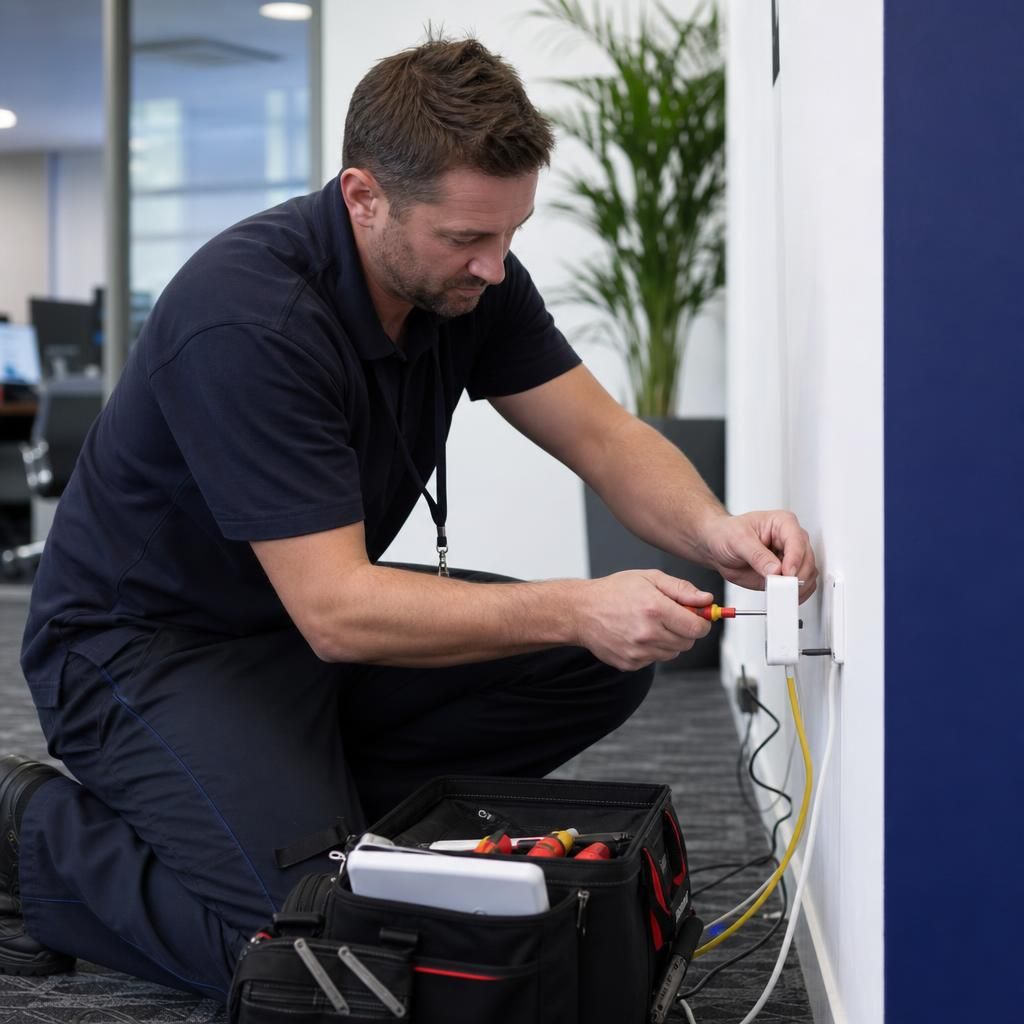
The process typically begins with a site and line assessment to determine whether an existing copper or fibre line can be used, or whether new infrastructure is required. Availability checks confirm the maximum speeds and technologies supported at the premises, such as FTTC, FTTP, or dedicated leased lines. Based on this, an installation date is agreed, and any necessary engineer attendance is booked in advance to minimise disruption.
On the day of installation, the engineer will fit or verify the master socket or fibre termination point, connect the router, and run diagnostic tests. Signal quality, sync speed, and error rates are checked to ensure the service meets specification. Where required, the engineer may also optimise router placement for Wi‑Fi coverage and verify that key devices can connect reliably.
After activation, configuration tasks are completed, including setting secure Wi‑Fi credentials, applying any static IP settings, and enabling security features such as firewalls. Remote monitoring and support options may also be set up, allowing performance to be tracked and issues to be resolved quickly. Final acceptance tests confirm that the broadband service is stable, secure, and ready to support business operations.
Boost Your Business Connectivity Today
Get your BT Business Broadband up and running with ease. Follow our guide to enhance your SME's internet performance and stay ahead in the competitive market.
Contact Us